Discovering the Deepest Secrets of Venus Planet with EnVision Mission
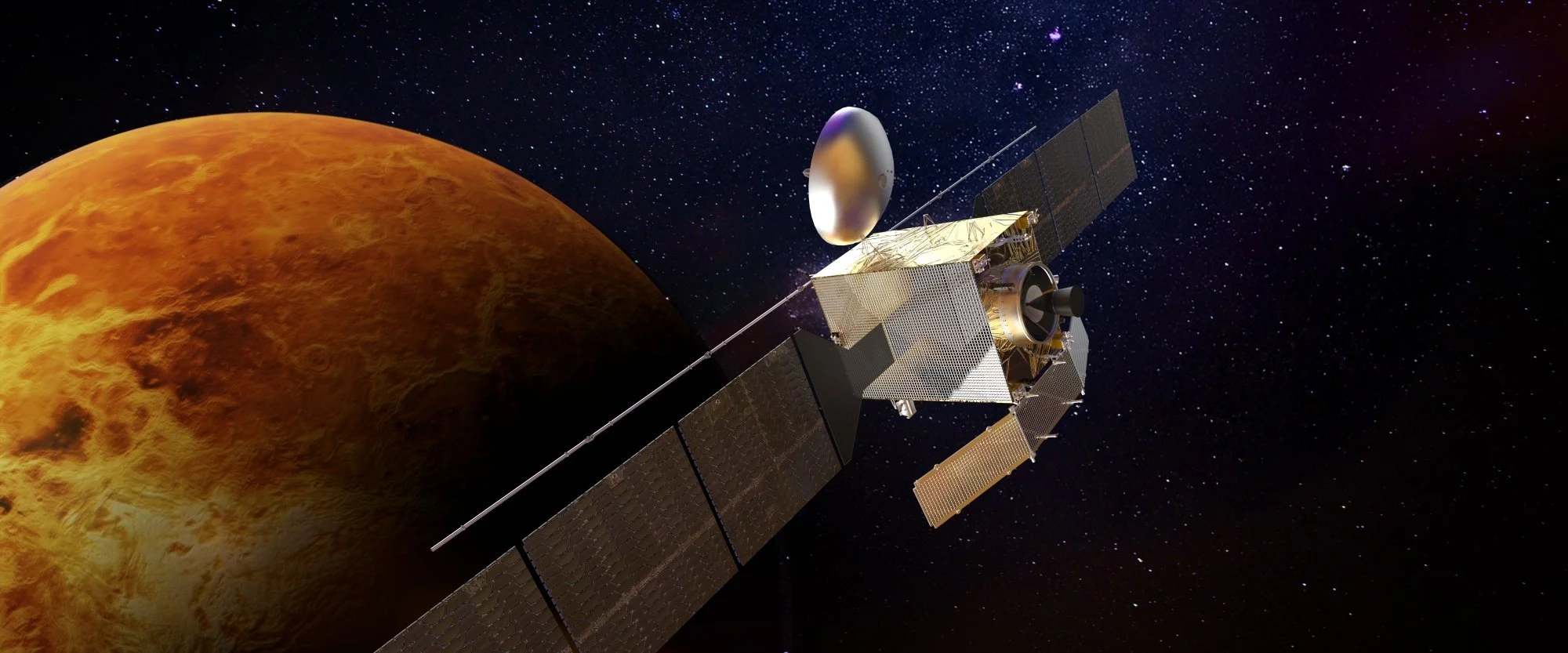
EnVision ©Thales Alenia Space / E.Briot
Thales Alenia Space, a joint venture between Thales (67%) and Leonardo (33%), has signed a contract with the European Space Agency (ESA) worth a total of 367 million Euros, for the supply of a satellite for ESA's EnVision mission to Venus. EnVision will embark five scientific instruments and a radio science experiment, to be carried out by the respective space agencies taking part in this exciting mission: the Italian Space Agency(ASI), the American space agency (NASA), the French space agency (CNES), the German aerospace research and technology centre (DLR) and the Belgian Science Policy Centre (BELSPO).
Venus and Earth: two “twin planets” that are so different
Some 20 years after the first European mission to Venus (Venus Express), EnVision's goal is to explore this planet accurately and systematically from its inner core to the upper layers of the atmosphere, analysing its interaction with the surface. The intention is to provide an integrated view of Venus, studying its history, activity and climate in an attempt to better understand why Earth's ‘twin’ planet, so similar in size and distance from the sun, is so different and uninhabitable today. EnVision is scheduled for launch in November 2031.
As the prime contractor, Thales Alenia Space will be responsible for the entire satellite, hosting five scientific instruments and an ultra-stable oscillator to perform radio science experiments.
“I wanted to sincerely thank the European Space Agency for putting its trust in our company,” Thales Alenia Space CEO Hervé Derrey said. “Thales Alenia Space took part to iconic space exploration and science interplanetary missions across the solar system, including Mars with ExoMars, Mercury with BepiColombo, the Sun with Solar Orbiter, asteroids and comets with Rosetta-Philae, Saturn with Cassini-Huygens, and tomorrow the Moon with Artemis, not to mention Euclid that will explore dark energy and dark matter to better understand the origin of the Universe’s accelerating expansion. This stunning mission will be a new step toward better understanding the deepest secrets of Venus, emphasizing in particular the many similarities and differences that exist between the Earth and the planet Venus, which is 41 million kilometers away from ours.”
“We are extremely proud to announce our contribution to ESA's EnVision mission in partnership with NASA, 20 years after the historic Venus Express mission. This new initiative, which follows on from the extraordinary BepiColombo and ExoMars 2016 missions, represents a significant milestone for the industry as well as for space research,” said Giampiero Di Paolo, Deputy CEO and Senior Vice President, Observation, Exploration and Navigation at Thales Alenia Space. “The EnVision mission, involving major international partners, is an ambitious program that will help us unravel the mysteries of the evolution of Venus, a planet so similar to Earth in many respects, but at the same time so different. With our experience and commitment, we are determined to support this crucial planetary mission, which promises to further our knowledge of our solar system.”
“We are thrilled to partner with Thales Alenia Space on this ground-breaking new mission to Venus” said ESA Science Director, Prof. Carole Mundell “No other mission has ever attempted such a comprehensive investigation of our remarkably inhospitable neighbour. EnVision will answer fundamental questions about how a planet becomes habitable – or the opposite.”
About the aerobraking phase:
The entry into orbit around Venus will include an aerobraking phase lasting several months, during which the orbit will be progressively circularised thanks to the friction of the satellite's surfaces with the planet's atmosphere. This will be a particularly delicate phase for the stability and temperature of the satellite. This will be followed by the actual scientific observation phase, which is expected to last about 6 Venusian years, corresponding to 4 Earth years.
Thanks to its consolidated experience as prime contractor on complex scientific missions, the last of which was Euclid, Thales Alenia Space will draw in particular on the aerobraking experience gained with ExoMars’ Trace Gas Orbiter in 2016.
ESA has authorised the next phases up to the spacecraft in-orbit commissioning around Venus. An important upcoming milestone will be the spacecraft system requirements review in 2025. In parallel, the selection of the industrial team will be completed and full authorisation to proceed with Phase C/D is expected in June 2026.
Thales Alenia Space leading the industrial consortium:
As prime contractor, Thales Alenia Space will be responsible for the entire satellite, featuring 5 scientific instruments and an ultra-stable oscillator to perform radio science experiments, provided by ESA Member States and NASA, in further detail:
• VenSAR (Venus Synthetic Aperture Radar)
• VenSpec suite (spectrometer suite) consisting of:
- VenSpec-H (High-Resolution Infrared Spectrometer)
- VenSpec-U (Ultraviolet Spectral Imager)
- VenSpec-M (Near-Infrared Mapping Spectrometer) and Central Control Unit (CCU)
• Subsurface Radar Sounder (SRS)
• Radio Science Experiment (RSE)
For the spacecraft Thales Alenia Space in Italy selected an Industrial Core Team composed of OHB, responsible for the mechanical, thermal, and propulsion subsystem, and Thales Alenia Space in France in charge of the Attitude and Orbit Control Subsystem (AOCS) and aerobraking analysis.
About the EnVision mission
The EnVision mission is dedicated to the study of Venus and was adopted in 2024 by ESA's Science Programme Committee as the 5th medium-class mission within the Agency's Cosmic Vision plan.
EnVision is an ESA-led mission in partnership with NASA that provides Synthetic Aperture Radar (VenSAR) and Deep Space Network support for mission-critical phases.
EnVision will reach Venus after a 15-month cruise. After its arrival, the orbiter will spend about a year aerobraking through Venus' atmosphere to gradually reach its scientific orbit, a near low-polar orbit of Venus, at an altitude of 220 to 540 km and with an orbital period of approximately 94 minutes.